
Government policy documents have grown steadily in size and complexity over the past decade, making careful analysis more demanding for researchers, journalists, students, and public policy professionals. Legislative bills, committee reports, consultation papers, budget documents, and regulatory guidance often span hundreds or even thousands of pages. The Organisation for Economic Co-operation and Development (OECD) has consistently highlighted the growing importance of evidence-based policymaking, a process that depends on thorough analysis of large volumes of government information. As document collections expand, many analysts are comparing traditional research methods with newer AI-assisted approaches.
Traditional policy research remains the foundation of political analysis, yet digital tools are becoming part of many research workflows. AI-powered document assistants like chat PDF reader can help users summarize lengthy reports, locate key passages, and organize information from complex PDFs. These technologies can reduce the time spent searching through legislation and public records. Even so, experienced researchers continue to rely on careful reading, independent verification, and expert judgment before reaching conclusions.
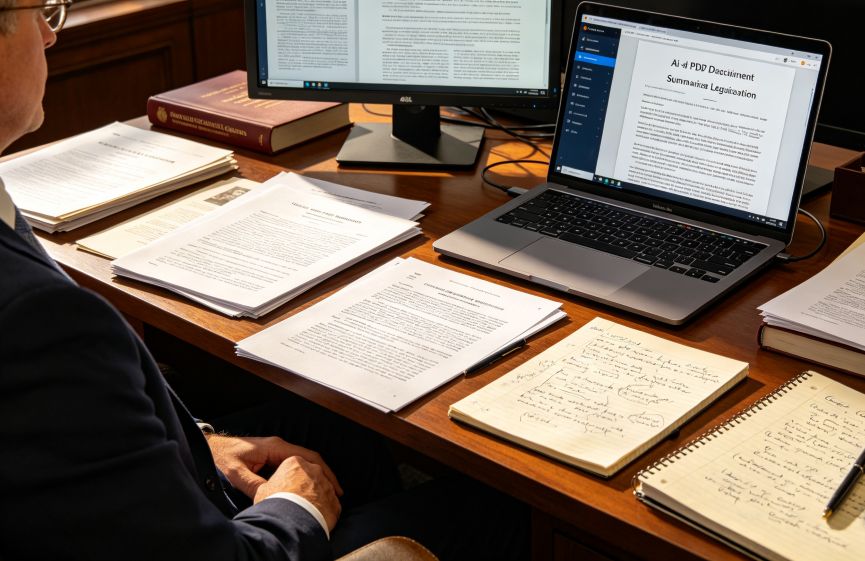
The Traditional Approach to Policy Research
Manual policy research has long been valued because it encourages close reading and careful interpretation. Analysts typically review legislation line by line, compare amendments, examine committee testimony, and study supporting government publications before forming an opinion.
This method takes time, yet it offers several advantages. Researchers gain a deeper understanding of political context, legal language, and institutional processes. They can recognize subtle wording changes that may affect the meaning of a bill or regulation. They are also better positioned to identify assumptions, inconsistencies, and policy trade-offs.
Political scientists frequently emphasize that laws rarely exist in isolation. The Congressional Research Service (CRS) explains that legislative interpretation often requires reviewing committee reports, prior statutes, judicial decisions, and administrative guidance together. Manual review naturally supports this broader perspective because researchers move beyond a single document.
The Growing Role of AI-Assisted Document Review
Artificial intelligence has introduced a different way to manage large collections of public documents. Instead of manually searching hundreds of pages, users can ask questions, request summaries, identify key themes, or locate specific sections within PDF files.
Modern document analysis systems use natural language processing to recognize relationships between sections of text. Rather than replacing careful reading, these tools help users identify where relevant information may appear. This can be particularly useful when reviewing lengthy legislative proposals, consultation papers, or government budget documents.
Research published by Stanford University’s Institute for Human-Centered Artificial Intelligence (HAI) notes that AI systems increasingly support knowledge work by improving information retrieval and summarization. These capabilities are especially valuable when researchers face tight deadlines or must compare multiple policy documents at once.
Comparing Speed and Efficiency
The biggest advantage of AI-assisted review is speed. Searching manually through several thousand pages can require many hours. AI document assistants can quickly identify sections discussing taxation, healthcare, environmental policy, procurement rules, or other specific topics.
This efficiency allows analysts to spend more time evaluating evidence instead of locating it. Journalists preparing election coverage, legislative staff reviewing amendments, or researchers comparing multiple reports may all benefit from faster document navigation.
Manual research, however, provides greater familiarity with the structure and flow of an entire document. Reading sequentially often reveals connections that automated summaries may overlook. Important qualifications sometimes appear in later sections, footnotes, or appendices, areas that deserve careful attention during political analysis.
Accuracy Versus Interpretation
The debate between manual research and AI-assisted review becomes more balanced when interpretation enters the discussion.
AI systems are effective at extracting information from text, identifying repeated themes, and summarizing lengthy documents. However, political analysis requires more than identifying words on a page. Researchers must understand historical context, legal precedent, institutional incentives, and public administration practices.
Experts at The Brookings Institution frequently note that policy evaluation depends on understanding implementation, stakeholder interests, and broader political environments. Those elements cannot always be inferred directly from legislative language alone.
For example, two bills may contain nearly identical wording while producing different outcomes because of funding mechanisms, administrative authority, or judicial interpretation. Human expertise remains essential for recognizing these distinctions.
Managing Large Document Collections
One area where AI demonstrates clear practical value is handling extensive document libraries. Government agencies regularly publish consultation responses, statistical releases, white papers, annual reports, regulatory impact assessments, and committee transcripts.
Reviewing these materials manually can become overwhelming, especially during active legislative sessions. Intelligent PDF analysis tools help organize documents, compare recurring topics, extract relevant sections, and highlight important references for later review. Readers interested in how educational institutions contribute to informed civic engagement can also explore campus media’s role in political awareness, which examines how student journalism helps explain political issues and encourages informed public discussion.
Rather than replacing researchers, these systems often function as efficient research assistants. They reduce repetitive tasks while allowing analysts to focus on evaluating evidence and building well-supported conclusions.
Potential Risks of Overreliance
Despite impressive improvements, AI-assisted document review has limitations that researchers should recognize.
Large language models occasionally generate inaccurate summaries, misunderstand complex legal wording, or overlook nuanced policy exceptions. Technical language found in legislation often depends on precise definitions that cannot be simplified without changing meaning.
Researchers should therefore verify AI-generated summaries against the original government documents. Fact-checking remains particularly important when analyzing proposed legislation, constitutional issues, international agreements, or judicial decisions.
Guidance from The National Institute of Standards and Technology (NIST) encourages organizations using AI to evaluate outputs carefully, identify potential errors, and maintain appropriate human oversight. These recommendations align closely with responsible political research practices.
Finding the Right Balance
The comparison between manual research and AI-assisted document review should not be viewed as a competition with only one winner. Each approach serves different purposes within the research process.
Manual reading builds subject knowledge, strengthens critical thinking, and encourages careful interpretation. AI-powered document review improves efficiency by accelerating searches, summarizing lengthy reports, and organizing large collections of information.
Many experienced researchers are combining both methods. They begin by using intelligent PDF assistants to identify relevant material, then perform detailed manual analysis before writing reports or publishing findings. This blended workflow saves time while preserving research quality.
Conclusion
Political analysis depends on accuracy, context, and thoughtful interpretation. While AI-powered PDF assistants and conversational document analysis platforms have made reviewing legislation and government publications faster, they cannot replace human reasoning or expert judgment. Manual policy research continues to provide the depth needed to understand political intent, legal implications, and institutional context.
The strongest research strategies increasingly combine both approaches. Automated document review can reduce repetitive work, improve navigation through extensive public records, and help identify relevant information more efficiently. Researchers, however, should continue validating findings against original sources, consulting credible evidence, and applying independent critical thinking. As governments publish larger volumes of digital information each year, combining careful human analysis with responsible AI-supported document review offers a practical path toward more informed and reliable political research.